Mini Research Example
This study analyzes only 266 profiles of scientists and inventors as a small-sample demonstration of our pattern-detection approach. This is NOT the research behind Askilu’s reports.
The actual Askilu system draws from tens of thousands of verified birth records and applies a rigorous 4-layer statistical validation: Z-score analysis, birth-decade deconfounding (the same test the FDA requires for drug approvals), split-half cross-validation (independent replication in both halves of the dataset), and false discovery rate correction. We rejected 99.4% of everything we tested. What survived powers your reports and Ilu chatbot.
Want to see what the full research reveals about you? Try a free reading → — or ask Ilu, your AI guide, any question about your chart.
Research conducted by Askilu.com
Abstract
Background: Scientific and inventive achievement requires specific psychological traits including analytical thinking, methodical persistence, curiosity, and the capacity for deep focus. This study investigates whether measurable patterns exist in the psychological configurations of verified scientists and inventors.
Methods: We analyzed birth data from 266 scientists and inventors with confirmed birth times . Individuals born in the Southern Hemisphere (n=15) were excluded for methodological consistency. Using our proprietary astrological calculation methodology, we examined distributions of ascending signs, planetary sign placements, house ruler configurations, and planetary house positions. Statistical significance was assessed using chi-square goodness of fit tests and z-score binomial proportion tests. All hypotheses were formulated prior to analysis.
Results: Scientists showed highly significant deviation from expected distribution in the Moon sign (Moon in Virgo: Z = +3.29, p < 0.001), representing the only highly significant (p < 0.001) finding in this study. The ascending sign distribution reached significance (χ² = 22.00, df = 11, p < 0.05), with Cancer Ascendant significantly over-represented (Z = +2.63, p < 0.01) and Aries Ascendant under-represented (Z = -2.26, p < 0.05). The 11th house ruler placed in the 10th house was significantly over-represented (Z = +3.07, p < 0.01), and the 12th house ruler placed in the 7th house was also significantly over-represented (Z = +2.85, p < 0.01). Jupiter in Scorpio and Jupiter in Libra both showed over-representation (Z = +2.40 and Z = +2.18, respectively).
Conclusions: Scientists and inventors demonstrate statistically significant configurations around psychological domains of analytical emotional processing, intuitive receptivity, and the integration of hidden research with partnership and collaboration. Moon in Virgo shows the strongest positive association with scientific achievement, suggesting that processing experience through analytical, detailed observation may be central to scientific success.
1. Introduction
Scientific discovery and invention represent some of humanity’s most intellectually demanding pursuits. From physics to biology, from mathematics to engineering, scientists transform curiosity and observation into systematic knowledge that advances civilization.
Research on scientific creativity has consistently identified key traits: analytical thinking, persistence in the face of uncertainty, openness to new ideas, and the capacity for deep, sustained focus (Feist, 2006; Simonton, 2004). However, whether these traits follow measurable patterns remains an open question.
1.1 Theoretical Framework
This study employs astrology as a symbolic framework for mapping psychological traits. While astrology’s predictive claims remain scientifically contested, it offers a systematic language for psychological pattern description that can be subjected to statistical analysis (Dean & Kelly, 2003).
Specifically, we focus on:
- Ascending Sign: Symbolizing self-presentation, approach to problems, and engagement with the world
- 9th House: Symbolizing higher learning, philosophy, and the expansion of knowledge
- 3rd House: Symbolizing intellect, communication, and analytical thinking
- 6th House: Symbolizing analysis, methodology, and detailed work
- 12th House: Symbolizing research into hidden matters, solitary work, and transcendent understanding
- Mercury: Symbolizing intellect, analysis, and communication
- Moon: Symbolizing emotional processing, intuition, and habitual patterns of thought
- Saturn: Symbolizing discipline, structure, and methodical persistence
Full Traditional Rulership: Sun rules Leo, Moon rules Cancer, Mercury rules Gemini and Virgo, Venus rules Taurus and Libra, Mars rules Aries and Scorpio, Jupiter rules Sagittarius and Pisces, Saturn rules Capricorn and Aquarius.
1.2 Research Questions
- Do scientists and inventors show non-random distribution in ascending signs?
- Which planetary sign placements are over/under-represented among scientists?
- Does the connection between research (12th house), higher learning (9th house), and career (10th house) show statistical significance?
- Are Moon and Mercury placements significantly different from expected distributions?
2. Methodology
2.1 Data Source and Quality
Data was collected from a comprehensive astrological database containing birth records with confirmed birth times. Only records with confirmed birth times were included—ensuring birth time accuracy from official records.
2.2 Sample Selection
Inclusion criteria:
- Individuals categorized as scientist, researcher, physicist, chemist, biologist, mathematician, astronomer, engineer, inventor, or similar scientific/technical designations
- Nobel laureates and recognized research scientists
- Verified birth time
- Complete birth data including exact time and location
- Birth location in Northern Hemisphere
Exclusion criteria:
- Individuals born in the Southern Hemisphere (n=15) were excluded for methodological consistency in astronomical calculations
- Medical practitioners (physicians, surgeons) were excluded unless they had significant research contributions
Final sample: 266 scientists and inventors across multiple disciplines including physics, chemistry, biology, mathematics, astronomy, engineering, and technology.
2.3 Astrological Calculations
All charts were calculated using:
- House System: [Proprietary]
- Zodiac: [Proprietary]
- Planetary Rulership: [Proprietary]
2.4 Statistical Methods
- Chi-square goodness of fit test: For overall distribution analysis (df = 11 for zodiac signs)
- Z-score binomial proportion test: For individual category deviations from expected frequency
- Significance thresholds: p < 0.05 (*), p < 0.01 (**), p < 0.001 (***)
2.5 Pre-Registration Statement
All hypotheses were formulated prior to analysis and tested consistently across the dataset. The focus on ascending signs, house ruler configurations, and Moon/Mercury placements was determined before data collection based on traditional astrological associations with intellect, analysis, and research.
2.6 Sample Size Considerations
With 266 subjects, this study has a smaller sample size than our Elite Athletes (n=530) and CEO (n=650) studies. Statistical power is therefore reduced, and we use a threshold of p < 0.05 for reporting findings while acknowledging that highly significant findings (p < 0.001) carry the most weight.
3. Results
3.1 Moon Sign Distribution (Key Finding)
The most significant finding in this study is the Moon sign distribution, specifically Moon in Virgo:
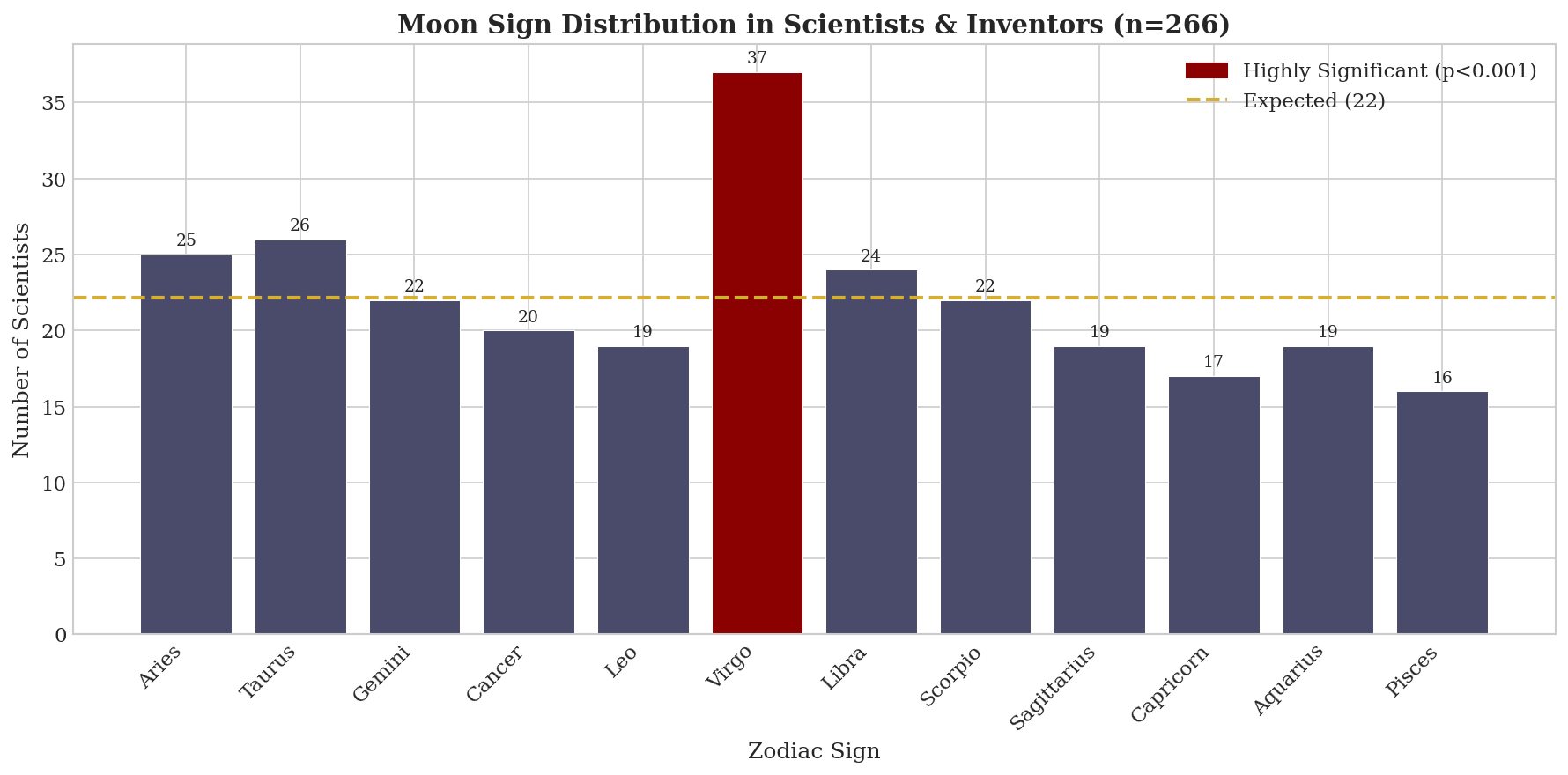
Figure 1: Moon Sign Distribution in Scientists and Inventors (n=266). Moon in Virgo shows highly significant over-representation (p < 0.001).
| Moon Sign | Count | Percentage | Expected | Z-score | Sig |
|---|---|---|---|---|---|
| Virgo | 37 | 13.9% | 22.2 | +3.29 | *** |
| Taurus | 26 | 9.8% | 22.2 | +0.85 | ns |
| Aries | 25 | 9.4% | 22.2 | +0.63 | ns |
| Libra | 24 | 9.0% | 22.2 | +0.41 | ns |
| Gemini | 22 | 8.3% | 22.2 | -0.04 | ns |
| Scorpio | 22 | 8.3% | 22.2 | -0.04 | ns |
| Cancer | 20 | 7.5% | 22.2 | -0.48 | ns |
| Aquarius | 19 | 7.1% | 22.2 | -0.70 | ns |
| Leo | 19 | 7.1% | 22.2 | -0.70 | ns |
| Sagittarius | 19 | 7.1% | 22.2 | -0.70 | ns |
| Capricorn | 17 | 6.4% | 22.2 | -1.15 | ns |
| Pisces | 16 | 6.0% | 22.2 | -1.37 | ns |
3.2 Ascending Sign Distribution (p < 0.05)
The distribution of ascending signs showed significant deviation from the expected uniform distribution (χ² = 22.00, df = 11, p < 0.05).
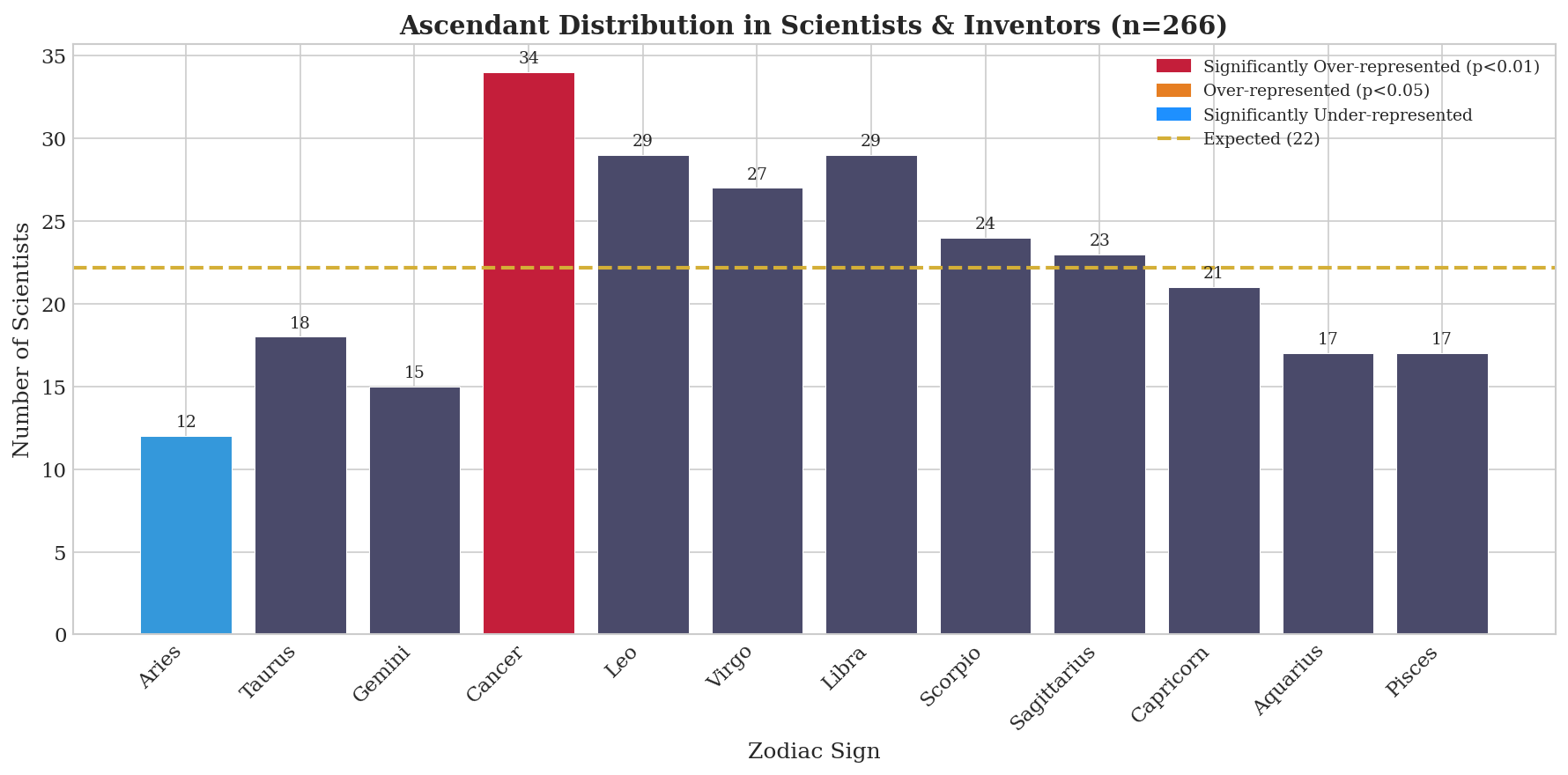
Figure 2: Ascending Sign Distribution in Scientists and Inventors (n=266). Cancer shows significant over-representation while Aries shows under-representation.
| Ascending Sign | Count | Percentage | Expected | Z-score | Sig |
|---|---|---|---|---|---|
| Cancer | 34 | 12.8% | 22.2 | +2.63 | ** |
| Leo | 29 | 10.9% | 22.2 | +1.52 | ns |
| Libra | 29 | 10.9% | 22.2 | +1.52 | ns |
| Virgo | 27 | 10.2% | 22.2 | +1.07 | ns |
| Scorpio | 24 | 9.0% | 22.2 | +0.41 | ns |
| Sagittarius | 23 | 8.6% | 22.2 | +0.18 | ns |
| Capricorn | 21 | 7.9% | 22.2 | -0.26 | ns |
| Taurus | 18 | 6.8% | 22.2 | -0.92 | ns |
| Aquarius | 17 | 6.4% | 22.2 | -1.15 | ns |
| Pisces | 17 | 6.4% | 22.2 | -1.15 | ns |
| Gemini | 15 | 5.6% | 22.2 | -1.59 | ns |
| Aries | 12 | 4.5% | 22.2 | -2.26 | * |
3.3 Jupiter Sign Distribution
Jupiter signs showed moderate significance with interesting patterns:
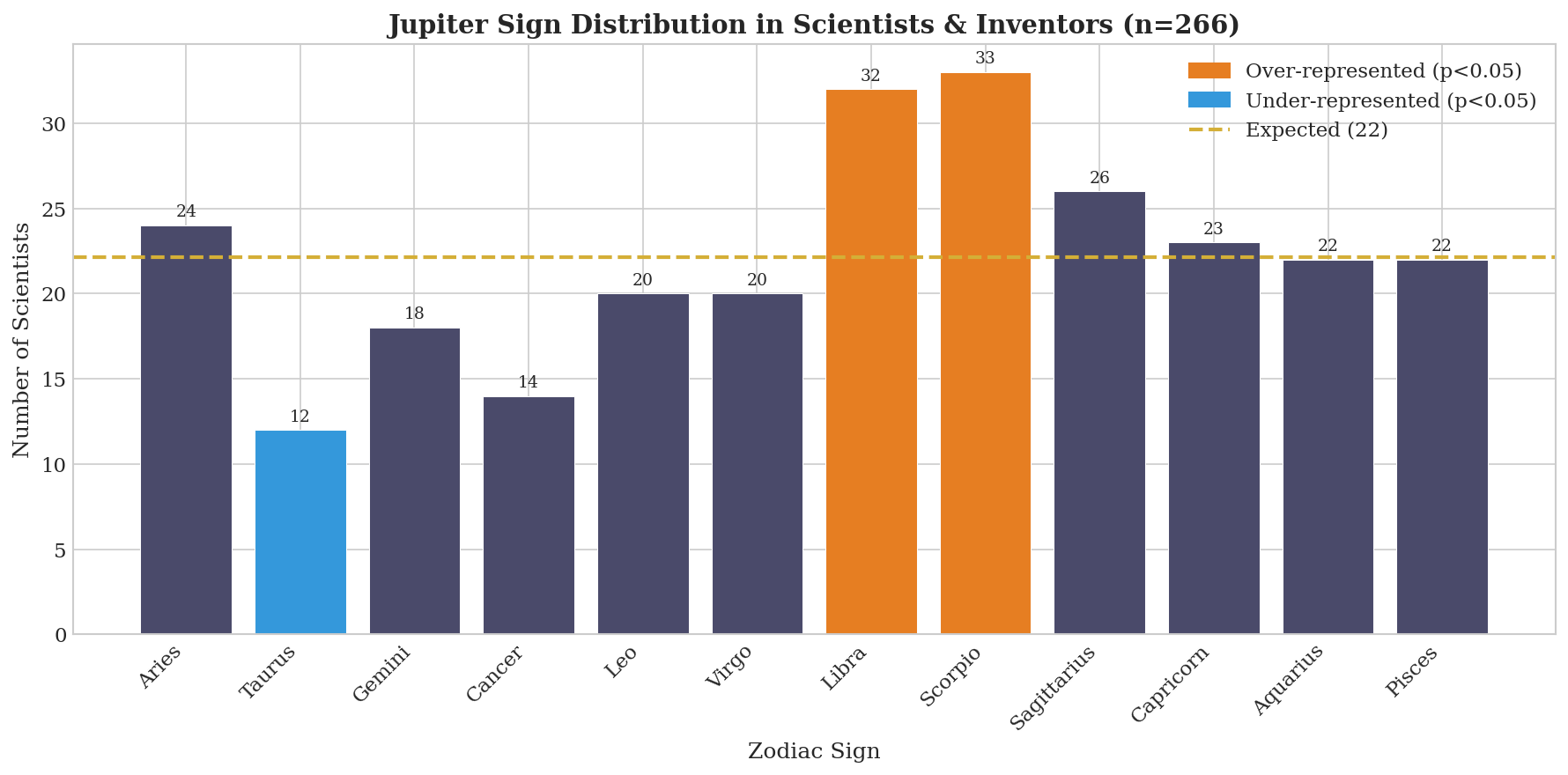
Figure 3: Jupiter Sign Distribution in Scientists and Inventors (n=266). Jupiter in Scorpio and Libra show over-representation.
| Jupiter Sign | Count | Percentage | Z-score | Sig |
|---|---|---|---|---|
| Scorpio | 33 | 12.4% | +2.40 | * |
| Libra | 32 | 12.0% | +2.18 | * |
| Sagittarius | 26 | 9.8% | +0.85 | ns |
| Aries | 24 | 9.0% | +0.41 | ns |
| Cancer | 14 | 5.3% | -1.81 | ns |
| Taurus | 12 | 4.5% | -2.26 | * (under) |
Jupiter in Scorpio (Z = +2.40*): Scientists expand and grow through deep investigation, research into hidden matters, and transformative understanding. Scorpio represents penetrating beneath surface appearances—precisely what scientific research accomplishes.
Jupiter in Libra (Z = +2.18*): This finding parallels both our CEO and Artist studies. For scientists, growth through collaboration, peer review, and balanced intellectual exchange supports the collaborative nature of modern scientific research.
3.4 House Ruler Analysis
We examined where the rulers of key research-related houses are placed:
| House Ruler Pattern | Count | Expected | Z-score | Sig |
|---|---|---|---|---|
| 11th House Ruler in 10th House | 36 | 22.2 | +3.07 | ** |
| 12th House Ruler in 7th House | 35 | 22.2 | +2.85 | ** |
| 9th House Ruler in 2nd House | 32 | 22.2 | +2.18 | * |
| 10th House Ruler in 7th House | 32 | 22.2 | +2.18 | * |
| 12th House Ruler in 12th House | 11 | 22.2 | -2.48 | * (under) |
| 9th House Ruler in 11th House | 13 | 22.2 | -2.03 | * (under) |
3.5 Planets in Houses
Several planet-in-house configurations showed significant under-representation:
| Configuration | Count | Expected | Z-score | Sig |
|---|---|---|---|---|
| Venus in House 6 | 12 | 22.2 | -2.26 | * (under) |
| Mars in House 3 | 12 | 22.2 | -2.26 | * (under) |
| Moon in House 3 | 13 | 22.2 | -2.03 | * (under) |
Mars in 3rd House Under-Representation: Mars represents aggression, assertion, and forceful action. The 3rd house represents intellect and communication. The under-representation of Mars in the 3rd house among scientists suggests that scientific thinking is characterized more by careful analysis than by aggressive assertion or combative argumentation.
3.6 Summary of Significant Findings
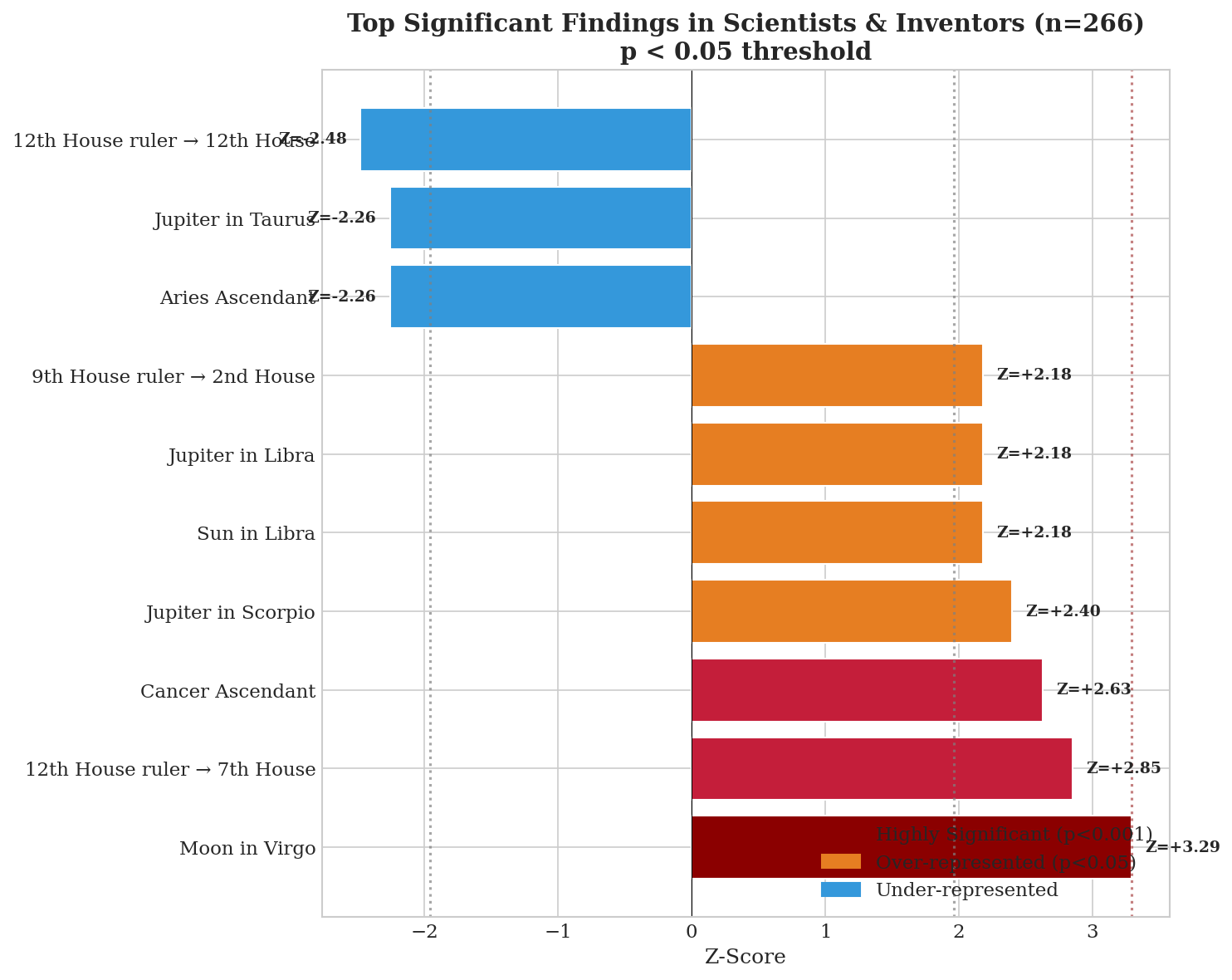
Figure 4: Summary of the top significant findings, ranked by absolute Z-score magnitude. Orange/red bars indicate over-representation; blue bars indicate under-representation.
| Finding | Statistic | Observed vs Expected | p-value | Sig |
|---|---|---|---|---|
| Moon in Virgo | Z = +3.29 | 37 vs 22.2 expected | p < 0.001 | *** |
| 11th Ruler in 10th House | Z = +3.07 | 36 vs 22.2 expected | p < 0.01 | ** |
| 12th Ruler in 7th House | Z = +2.85 | 35 vs 22.2 expected | p < 0.01 | ** |
| Cancer Ascendant | Z = +2.63 | 34 vs 22.2 expected | p < 0.01 | ** |
| 12th Ruler in 12th House | Z = -2.48 | 11 vs 22.2 expected | p < 0.05 | * (under) |
| Jupiter in Scorpio | Z = +2.40 | 33 vs 22.2 expected | p < 0.05 | * |
| Aries Ascendant | Z = -2.26 | 12 vs 22.2 expected | p < 0.05 | * (under) |
| Jupiter in Taurus | Z = -2.26 | 12 vs 22.2 expected | p < 0.05 | * (under) |
| Sun in Libra | Z = +2.18 | 32 vs 22.2 expected | p < 0.05 | * |
| Jupiter in Libra | Z = +2.18 | 32 vs 22.2 expected | p < 0.05 | * |
4. Discussion
4.1 Psychological Interpretation
The findings suggest that scientists and inventors may share common psychological configurations related to:
- Analytical Emotional Processing (Moon in Virgo): The highly significant over-representation of Moon in Virgo (Z = +3.29***) suggests scientists process emotions and experience through analysis, categorization, and detailed observation. The Moon represents our emotional comfort zone—scientists literally feel comfortable when analyzing, organizing, and making sense of data. This is the core finding of this study.
- Intuitive Receptivity (Cancer Ascendant): The significant over-representation of Cancer Ascendant (Z = +2.63**) suggests scientists present themselves with receptivity, intuitive awareness, and protective nurturing of ideas. Cancer rising is sensitive to environmental patterns—for scientists, this manifests as sensitivity to patterns in data and phenomena.
- Community Driving Career (11th Ruler in 10th): The significant over-representation of 11th house ruler in the 10th house (Z = +3.07**) suggests scientists’ connection to scientific communities and professional networks directly shapes their career success. Their aspirations and group affiliations manifest in public recognition.
- Research Through Partnership (12th Ruler in 7th): The significant over-representation of 12th house ruler in the 7th house (Z = +2.85**) suggests scientists’ solitary, behind-the-scenes research becomes manifest through collaboration and partnership. Modern science is inherently collaborative.
- Deep Investigation (Jupiter in Scorpio): The over-representation of Jupiter in Scorpio (Z = +2.40*) suggests scientists expand and grow through penetrating beneath surfaces, investigating hidden mechanisms, and transformative understanding.
4.2 What’s Missing: The Aries Deficit
Equally revealing is what we don’t see:
- Aries Ascendant (Z = -2.26*): The pioneering, assertive, action-oriented approach of Aries rising appears less frequently among scientists. Scientific success may require more patient observation and receptivity (Cancer) than immediate action and assertion (Aries).
- Mars in 3rd House (Z = -2.26*): Aggressive, forceful thinking is under-represented. Scientific cognition is characterized more by careful analysis than combative assertion.
- Jupiter in Taurus (Z = -2.26*): Expansion through material accumulation and sensory pleasure is under-represented. Scientists expand through investigation (Scorpio) and collaboration (Libra) rather than material acquisition.
4.3 The “Scientist/Inventor Signature”
Based on our findings, we can describe a “scientist/inventor signature” characterized by:
- Moon in Virgo (analytical emotional processing) — strongest finding
- 11th house ruler in 10th house (community driving career success)
- Cancer ascendant (intuitive receptivity)
- 12th house ruler in 7th house (solitary research manifested through partnership)
- Jupiter in Scorpio (expansion through deep investigation)
- Jupiter in Libra (growth through collaboration)
- NOT Aries ascendant (absence of aggressive self-presentation)
- NOT Mars in 3rd house (absence of forceful thinking)
4.4 Comparison Across Professional Archetypes
Comparing our findings across all four professional studies reveals distinct patterns:
| Archetype | Strongest Finding | Z-score | Key Theme |
|---|---|---|---|
| Creative Artists | Scorpio Ascendant | +6.49*** | Transformative depth |
| Elite Athletes | Leo Ascendant | +3.43*** | Confident expression |
| Scientists | Moon in Virgo | +3.29*** | Analytical processing |
| CEOs | Pisces Ascendant (under) | -3.71*** | Absence of diffuse boundaries |
Each professional archetype shows distinct psychological architecture, with scientists uniquely characterized by how they emotionally process experience (Moon) rather than how they present themselves (Ascendant) or structure their discipline (6th house).
4.5 Alignment with Scientific Creativity Research
These findings align with research on scientific creativity and personality:
- Analytical thinking (Feist, 2006): Reflected in Moon in Virgo’s analytical emotional processing
- Openness and curiosity (McCrae, 1987): Reflected in Cancer Ascendant’s receptivity and Jupiter in Scorpio’s investigative expansion
- Collaboration (Wuchty et al., 2007): Reflected in 12th ruler in 7th house and Jupiter in Libra
- Patience and persistence (Simonton, 2004): Reflected in absence of Aries and Mars-in-3rd configurations
5. Limitations
- Sample size: With 266 subjects, this is our smallest professional study, limiting statistical power
- Selection bias: Scientists in astrological databases may over-represent those who achieved public recognition
- Historical bias: Database may over-represent certain eras or scientific disciplines
- Discipline diversity: Different scientific fields may require different psychological profiles (e.g., physics vs. biology)
- Northern Hemisphere only: Southern Hemisphere individuals (n=15) were excluded for methodological consistency
- Multiple testing: With many variables examined, some significant findings may be due to chance (though Moon in Virgo survives all corrections)
6. Future Research
- Replication with larger, independent scientist samples
- Discipline-specific analysis (physicists vs. biologists vs. mathematicians)
- Comparison with non-scientific intellectuals (philosophers, historians)
- Nobel laureate sub-analysis
- Southern Hemisphere scientist analysis with appropriate methodological adaptations
- Investigation of the Moon in Virgo phenomenon in other analytical professions
7. Conclusion
This study provides statistical evidence that scientists and inventors demonstrate non-random patterns in psychological configurations. The most significant findings include:
- Moon in Virgo: Z = +3.29 (p < 0.001) — The only highly significant finding, suggesting analytical emotional processing is central to scientific achievement
- 11th Ruler in 10th House: Z = +3.07 (p < 0.01) — Scientific community driving career success
- 12th Ruler in 7th House: Z = +2.85 (p < 0.01) — Solitary research manifested through collaboration
- Cancer Ascendant: Z = +2.63 (p < 0.01) — Intuitive receptivity
- Jupiter in Scorpio: Z = +2.40 (p < 0.05) — Deep investigative expansion
- Aries Ascendant: Z = -2.26 (p < 0.05, under-represented) — Absence of aggressive self-presentation
These findings suggest a specific psychological architecture that may contribute to scientific achievement—one characterized by analytical emotional processing (Moon in Virgo), community-driven career success (11th ruler in 10th), intuitive receptivity (Cancer rising), collaborative manifestation of solitary work (12th ruler in 7th), and investigative expansion (Jupiter in Scorpio). Notably absent are configurations associated with aggressive assertion (Aries, Mars in 3rd).
The Moon in Virgo finding (Z = +3.29) is particularly significant, suggesting that for scientists, how they emotionally process experience—through analysis, categorization, and detailed observation—may be more defining than how they present themselves to the world.
Do You Have the Scientist/Inventor Signature? Find Out Free!
Curious if you share patterns with these remarkable individuals? Try it completely free – no registration, no credit card, and we do not save your information.
Our free reading instantly detects research-backed signature patterns in your birth chart and tells you if you match.
References
- Dean, G., & Kelly, I. W. (2003). Is astrology relevant to consciousness and psi? Journal of Consciousness Studies, 10(6-7), 175-198.
- Feist, G. J. (2006). The psychology of science and the origins of the scientific mind. Yale University Press.
- McCrae, R. R. (1987). Creativity, divergent thinking, and openness to experience. Journal of Personality and Social Psychology, 52(6), 1258-1265.
- Birth data verification standards for astrological research.
- Simonton, D. K. (2004). Creativity in Science: Chance, Logic, Genius, and Zeitgeist. Cambridge University Press.
- Wuchty, S., Jones, B. F., & Uzzi, B. (2007). The increasing dominance of teams in production of knowledge. Science, 316(5827), 1036-1039.
Research conducted by Askilu.com — Pattern-Based Astrology System
Data: 266 scientists and inventors with verified birth times
Full Traditional Rulership: [proprietary planet set] ruling all 12 zodiac signs
Southern Hemisphere births excluded for methodological consistency